What Size Paint by Numbers Should You Choose? The Honest Sizing Guide
1. Standard paint by numbers sizes
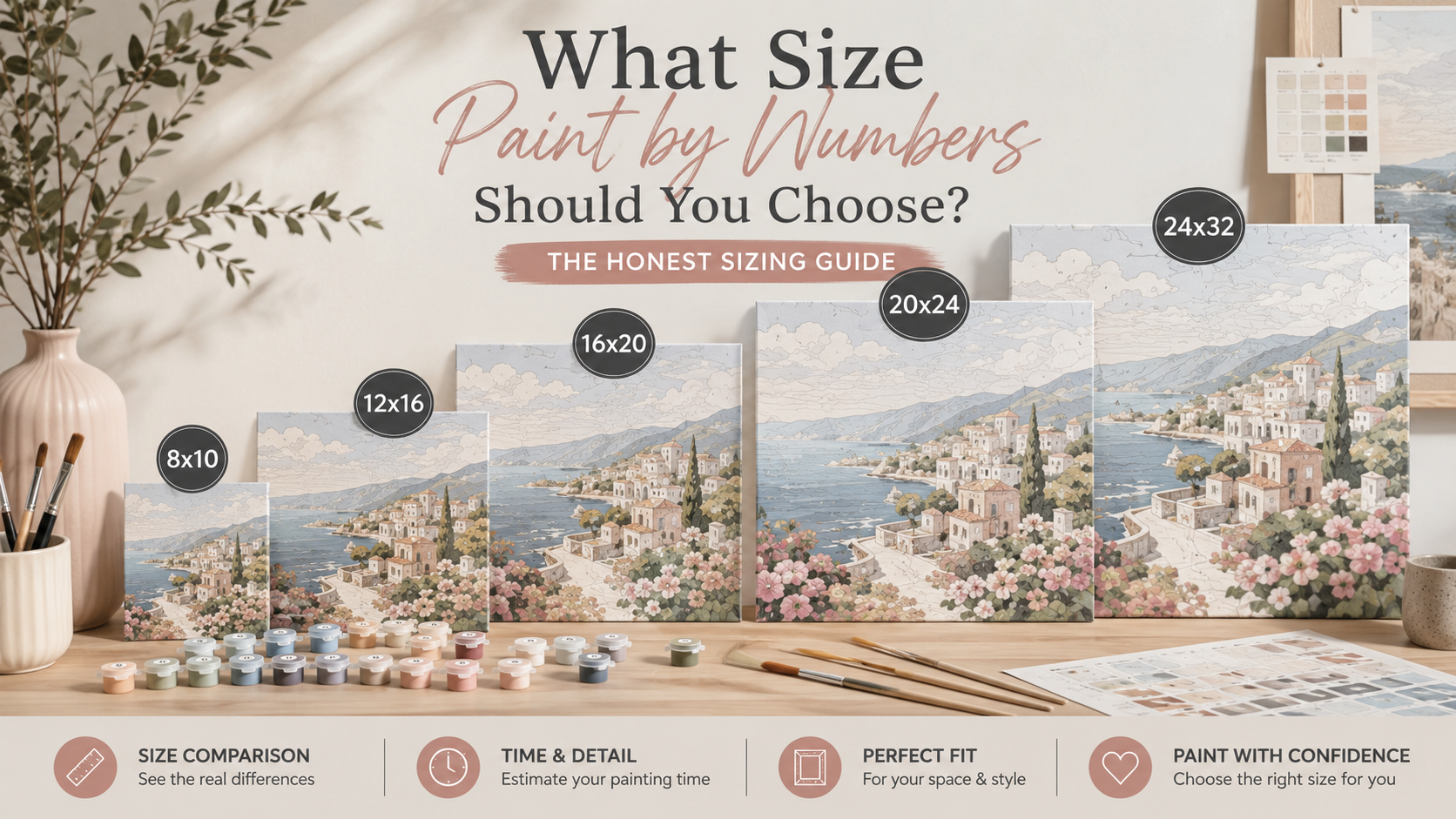
Most adult kits fall into four useful groups:
- 8x10 inches: compact; best for simple subjects
- 12x16 inches: approachable for beginners and small tables
- 16x20 inches: the most versatile balance of detail and display
- 20x24 to 24x32 inches: suited to complex scenes and statement pieces
A paint by numbers 16x20 kit is close to 40x50 centimeters; the exact conversion is about 15.7x19.7 inches. Check whether a listing measures the printed image or the entire canvas, since rolled canvases often include an unpainted border for stretching. Our complete guide covers other kit details to check.
2. Comparison table: size, sections, hours
Use these as planning ranges for moderate-detail designs with roughly 24 to 36 colors. “Sections” means individual numbered shapes.
| Canvas size | Approx. sections | Active painting time | Best use |
|---|---|---|---|
| 8x10 | 300–700 | 5–10 hours | Minis, simple florals |
| 12x16 | 700–1,400 | 10–20 hours | First kits, small portraits |
| 16x20 | 1,200–2,500 | 20–35 hours | Landscapes, pets |
| 20x24 | 1,800–3,500 | 25–45 hours | Detailed portraits |
| 24x32 | 2,500–5,000+ | 40–70 hours | Complex statement art |
These are estimates, not guarantees. Two kits with identical dimensions may differ sharply: a misty beach can have broad areas, while a flower market may contain thousands of tiny shapes.

3. Workspace requirements per size
For any paint by numbers size, your surface should extend beyond the canvas so there is room for paint pots, brushes, water, and your forearm. A 16x20 canvas is comfortable on a surface around 24x30 inches. For 20x24 and larger pieces, aim for roughly 30x36 inches or mount the canvas on a lightweight board.
Plan storage before buying. From customer feedback, one pattern stands out: large kits are easier to finish when painters can leave them safely set up instead of clearing the dining table after every session.
4. How size and difficulty relate
Larger does not always mean harder. When the same image is enlarged, tiny numbered areas become easier to see and fill, so a 20x24 portrait may feel more comfortable than a 12x16 version.
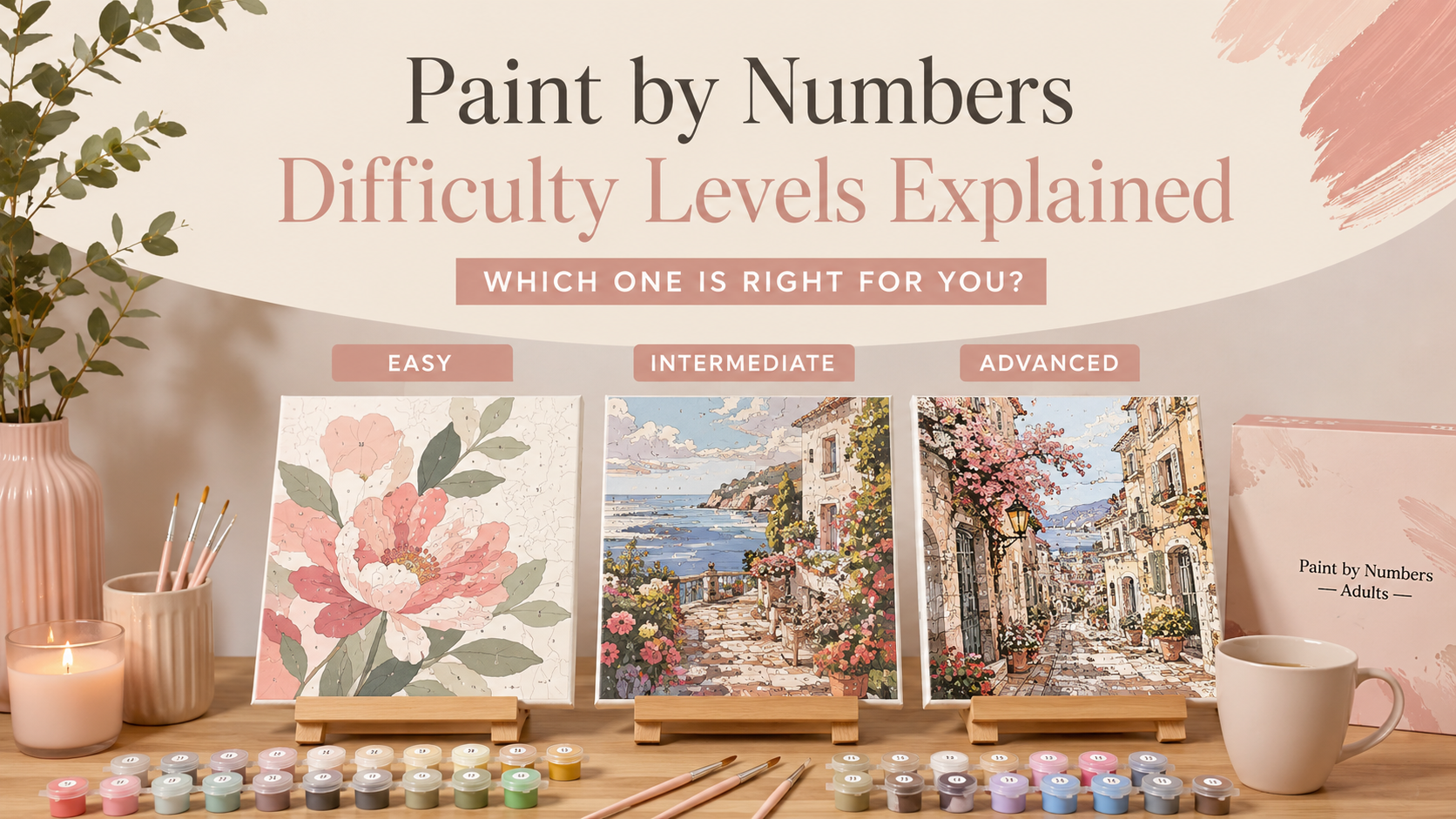
Difficulty increases when the larger format also adds sections, color transitions, faces, fur, foliage, or architecture. For your first project, prioritize clear shapes rather than the shortest advertised completion time. A moderately detailed 16x20 landscape is often friendlier than a miniature crowded with detail. See our guide to difficulty levels for more help.
5. Which size fits which motif
Match the canvas to the amount of visual information:
- 8x10 to 12x16: single flowers, simple animals, and graphic designs
- 16x20: most landscapes, one-person portraits, pets, and still lifes
- 20x24 to 24x32: group photos, city scenes, gardens, and intricate fantasy art
For custom-from-photo kits, size up when faces occupy only a small part of the picture. A close-up dog portrait may work beautifully at 16x20, while a family photo with five people benefits from 20x24 or larger.
6. Estimating your wall space
Before settling on a paint by numbers size, measure the wall and mark the finished outline with painter’s tape. Artwork above furniture often looks balanced at roughly one-half to two-thirds of the furniture’s width, although that is a guideline rather than a rule.
A 16x20 piece suits a narrow wall or gallery arrangement. A 24x32 canvas has enough presence to hang alone. Include the outer frame in your calculation: a two-inch frame adds about four inches to both dimensions, turning a 16x20 image into an approximately 20x24 wall piece.
7. When mini kits make sense
Mini kits suit shorter projects, limited setup, travel, gifts, and first attempts. Choose artwork with bold shapes and limited tiny detail; crowded family photos, buildings, and full-body pet scenes usually lose clarity when reduced too far.
Small canvases also work well as a coordinated set. Three 8x10 paintings can cover more wall width than one 16x20 piece while giving you three manageable finish lines. Explore mini paint by numbers designed to remain clear at a compact scale.
8. Are large 24x32 kits really worth it?
A 24x32 kit is worth it when the image needs room for facial features, petals, reflections, or architectural lines—and when you enjoy a long project. It can create a true focal point, especially for an important custom photo.
The tradeoffs are more workspace, longer painting time, and higher framing costs. Choose this format for a complex motif you plan to display prominently. Skip it when you need a quick finish or must pack everything away after each session. The largest paint by numbers size is valuable only when the subject, room, and your habits support it.

9. Framed vs. unframed sizing differences
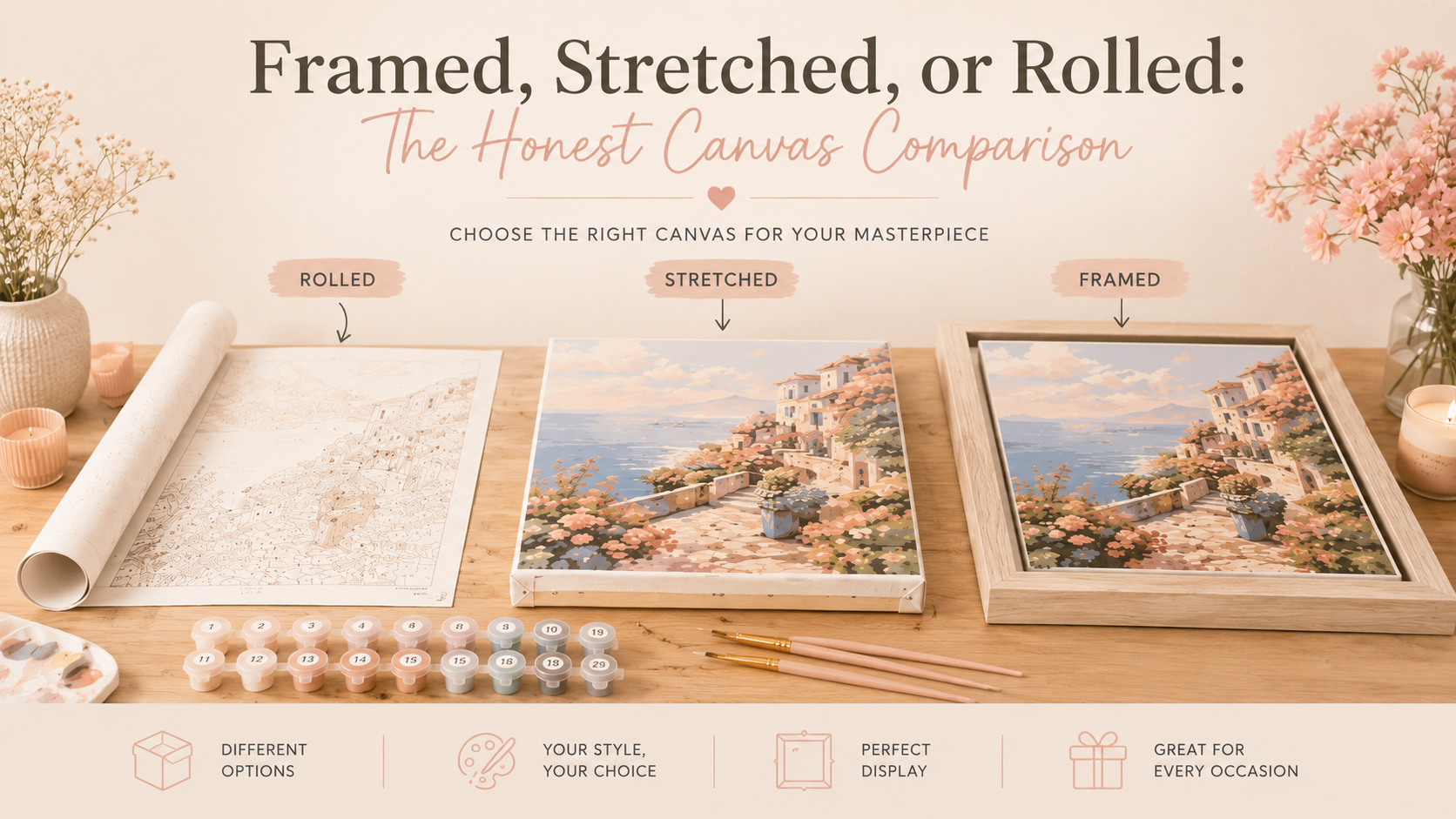
A framed kit is already stretched over wooden bars, so its listed dimensions are usually close to the finished display size before adding a decorative outer frame. A rolled canvas may include blank material around the printed image for later stretching; that border is not visible artwork.
Confirm whether the listed paint by numbers dimensions refer to the image area, full canvas area, or stretcher-frame size. If you plan to frame the painting later, allow for wrap depth, matting, and frame width. Our comparison of framed vs. rolled explains the practical differences in setup, shipping, and display.
FAQ
1. What size is best for beginners?
A 16x20-inch canvas is the best all-around size for most beginners. It gives numbered areas enough room to stay readable without demanding a huge table or an extremely long commitment. Choose 12x16 for a simple motif or limited workspace, but avoid a highly detailed mini as your first project.
2. Is 16x20 too small for a living room?
No, 16x20 is not automatically too small for a living room. It works above a narrow console, on a smaller wall, or within a gallery arrangement. Above a wide sofa, one 16x20 piece may feel undersized; pair it with other art or choose 20x24 to 24x32 for stronger presence.
3. How many sections does a 20x24 average?
A 20x24 kit commonly has about 1,800 to 3,500 numbered sections. There is no universal average because section density depends on the motif, color count, and conversion method. A simple sunset may have far fewer shapes than a portrait, flower market, or city scene in the same dimensions.
4. How much wall space do I need?
Plan for the finished artwork plus at least 2 to 4 inches of breathing room around it. Include any outer frame in your measurement: a two-inch frame adds about four inches to the total width and height. Use painter’s tape to test the final outline on the wall before ordering.
5. Does size affect painting time significantly?
Yes, size can change painting time significantly, especially when a larger version includes more detail. A moderate 16x20 kit may take 20 to 35 active hours, while a detailed 24x32 kit can require 40 to 70. If the design is simply enlarged without extra sections, the difference may be smaller.

Choose a size that fits both your subject and the way you actually paint. Explore our paint by numbers kits to find a 16x20 canvas that gives your details enough room without overtaking your workspace.