Article: Framed, Stretched, or Rolled: The Honest Canvas Comparison
Framed, Stretched, or Rolled: The Honest Canvas Comparison
1. Three canvas options - the differences at a glance
Canvas labels are not always consistent, so focus on what physically arrives. Across paint by numbers for adults, you will usually see three formats:
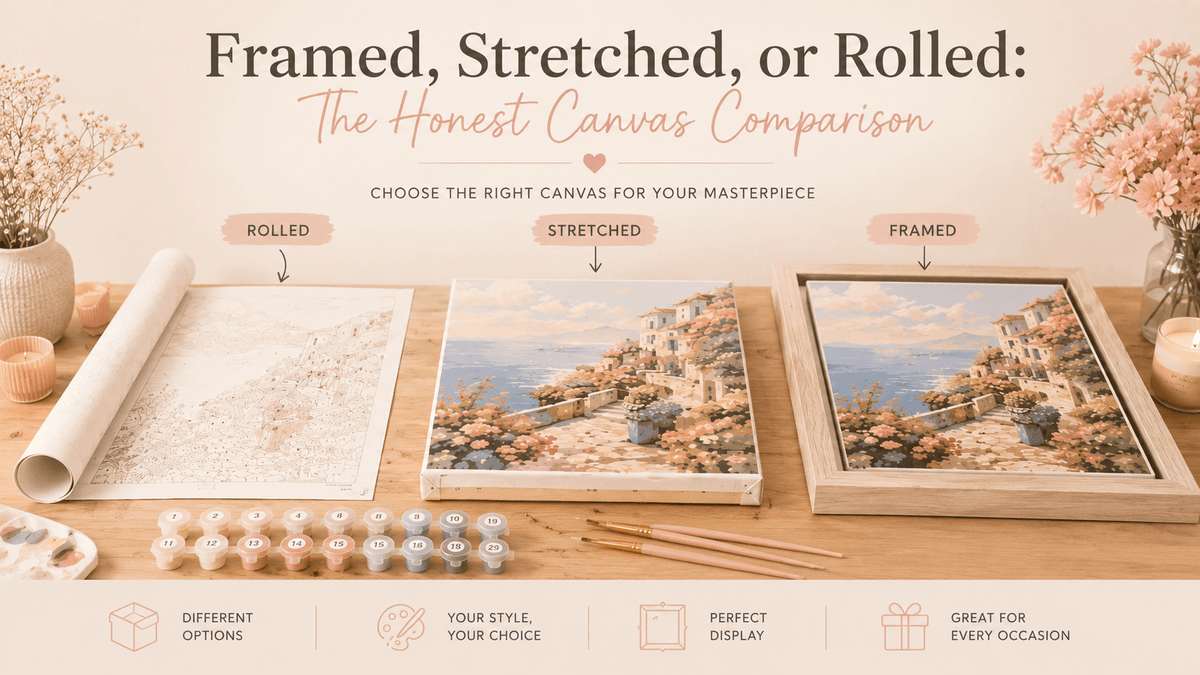
- Stretched canvas: The printed canvas is pulled tightly over wooden stretcher bars and stapled at the back. It is ready for an easel or table and can often be hung without another frame.
- Rolled canvas: The printed canvas arrives loose, normally rolled rather than folded. You paint it on a flat board or stretch it first.
- Pre-framed canvas: Here, that means a stretched canvas with a decorative outer frame already included.
One warning: some stores use “framed” when they only mean “stretched on wooden bars.” Check the product photos for a visible decorative border and read the included-items list. The practical distinction is simple: stretched prioritizes convenience, rolled prioritizes flexibility, and pre-framed prioritizes presentation. This distinction prevents surprises and helps you compare prices between sellers fairly.
2. On a stretcher frame: the standard experience
A paint by numbers stretched canvas gives you a firm, even surface from the first brushstroke. It does not slide around, the numbered areas stay easier to read, and you can rotate the whole piece as you work. You also avoid taping the canvas to a board or dealing with edge waves.
From our customers’ feedback, beginners value this convenience more than expected. Opening the kit, organizing the paints, and starting immediately removes one extra task. It is especially useful for detailed portraits, where a loose canvas shifting slightly becomes annoying.
The trade-off is size. Stretcher bars make the parcel bulkier, require more storage space, and are less convenient for flights or small apartments. A stretched canvas is also not automatically “finished-looking.” You may still want a floating frame, painted edges, or hanging hardware after the artwork is complete. Even so, it is the easiest option for most home painters.
3. Rolled canvas: when it makes sense
A rolled canvas paint by numbers kit is the most flexible option. It stores compactly, travels well, and lets you choose your own stretcher bars or frame later. It makes sense when you own a rigid painting board or want control over the final presentation.
Secure the canvas to a flat surface with low-tack painter’s tape or clips. Do not pull one corner harder than the others, because uneven tension can distort the printed shapes. If it arrives with light waves, flatten it first; our guide on how to iron canvas explains a safe low-heat method from the back.
The compromise is extra setup. You need a board large enough for the design and must decide how it will be displayed. When you plan to stretch it yourself, keep roughly 2 inches of spare canvas around each edge whenever the design allows. That margin gives you material to pull around the bars and staple securely.

4. Pre-framed: the complete gift package
A true framed paint by numbers kit includes both the stretched canvas and a decorative outer frame. It is the closest option to an all-in-one gift: the recipient paints the design, lets it dry, and has a piece nearly ready for the wall. This works well for birthdays, anniversaries, housewarmings, and custom-from-photo portraits.
Presentation is the advantage, but it reduces flexibility. The frame color, width, and style are already chosen. A modern black frame may suit one home and feel too strong in another. The package is also heavier and more vulnerable to corner damage during shipping.
Protect the frame with painter’s tape before painting near the edges, and confirm whether hanging hardware is included. “Pre-framed” sometimes describes the appearance rather than a complete hanging system. For someone whose home style you know well, it is wonderfully convenient. When you are unsure about their decor, stretched canvas is often the safer middle ground.
5. Comparison table: price, effort, presentation
The cheapest option at checkout is not always the cheapest finished artwork. A rolled canvas may cost less initially, but professional stretching or custom framing can erase the difference. Use our size guide before ordering, because larger sizes magnify shipping and framing considerations.
| Canvas option | Upfront cost | Setup | Painting feel | Work after painting | Best for |
|---|---|---|---|---|---|
| Rolled | Lowest | Tape to a board or stretch | Depends on support | Stretch, mount, or frame | Travel and custom framing |
| Stretched | Medium | Minimal | Firm and stable | Add hardware or an optional frame | Most painters |
| Pre-framed | Highest | Protect the outer frame | Firm and stable | Usually minimal | Ready-to-present gifts |
For most adults painting at home, stretched canvas offers the best balance. Rolled canvas is useful when compact shipping or frame choice matters more than immediate convenience. Pre-framed is strongest when finished presentation is part of the purchase. Think about the total finished cost, not only the kit price shown online.

6. What happens after you finish painting
Your canvas format determines the final steps. With a rolled canvas, let the painting dry flat, then choose between stretching it, mounting it to a rigid panel, or placing it in a frame. Our guide on how to frame covers the planning points before you cut or staple anything.
A stretched canvas can be displayed as-is, especially when the design wraps neatly around the sides. You can paint the edges, leave them natural, add hanging wire, or place the canvas inside a floating frame. A pre-framed piece needs only touch-ups and wall hardware.
Whichever format you choose, give the final section at least a full day before wrapping, pressing, or framing the work. Acrylic may feel dry quickly while thicker areas remain softer underneath. Varnish is optional; test compatibility and follow its instructions. Avoid placing glass directly against the painted surface, because contact can cause sticking or marks over time.
7. Which option is transportable and shipping-friendly
For travel before painting, rolled canvas is the clear winner. It fits inside a tube, uses less storage space, and avoids the rigid corners that make stretched canvases bulky. That helps when you are taking a kit on a flight, sending it overseas, or hiding a custom gift.
Stretched canvas is manageable for transport, but it needs a box that protects the face, edges, and corners. Pre-framed artwork requires the most protection because both the canvas and decorative frame can be damaged.
Once painted, flat transport is safest. Never fold a finished canvas. If a cured piece must be rolled, use a wide core, a nonstick layer, and a loose roll rather than tight pressure. For mailing a completed gift, stretched canvas is often the practical compromise: more presentation-ready than rolled, but lighter and less fragile than a decorative frame. Secure paint pots separately when traveling with an unfinished kit.
8. Recommendation by occasion and recipient
Choose the format around the person and final destination, not simply the lowest price.
- For your first kit: Choose stretched canvas. The stable surface keeps your attention on painting.
- For travel or limited storage: Choose rolled canvas and use a lightweight backing board.
- For someone who enjoys choosing frames: Choose rolled, provided they are comfortable mounting or stretching it.
- For a ready-to-open gift: Choose pre-framed when you know the recipient’s decor and the listing includes a true outer frame.
- For a custom portrait: Stretched canvas is usually the safest balance because it feels substantial but still allows a frame later.
Our team has seen gift buyers focus on a beautiful frame, then learn that the recipient preferred another finish. When style is uncertain, convenience without permanent decoration is better. For more help selecting a kit, read our complete guide. This article is also part of our Paint by Numbers Hub.
Frequently Asked Questions
Do I need a separate frame for a rolled canvas?
Usually, yes—if you want a traditional stretched or framed display.
A rolled canvas arrives without wooden bars or a decorative frame. You can instead mount it to a rigid panel, use a magnetic poster hanger, or keep it flat in a portfolio, but most permanent wall displays require additional support.
Can I stretch the canvas onto a frame myself?
Yes, you can stretch it yourself with the right tools and even tension.
You will need correctly sized stretcher bars, a staple gun, and a clean work surface. Canvas pliers help but are not essential for smaller pieces. Work from the center of each side toward the corners, keep the frame square, and avoid distorting the printed design.
Are pre-framed kits more expensive?
Generally, yes.
You are paying for the decorative frame, additional assembly, a larger shipping box, and more protection in transit. However, compare the total finished cost: a cheaper rolled canvas can become more expensive if you later pay a professional to stretch and custom-frame it.
Which option is better as a gift?
Pre-framed is best when you know the recipient’s decor and want a complete presentation.
Stretched canvas is the safer all-around gift because it is ready to paint but leaves the final frame choice open. Rolled canvas suits experienced painters who enjoy mounting or framing their own work.
Is the painting technique different on rolled canvas?
No, the number-matching and painting technique are the same.
The difference is surface preparation. A rolled canvas should be flattened and secured to a rigid board so it stays smooth while you paint. Once supported properly, you can use the same brushes, acrylic paints, and section-by-section process.

Ready to choose the format that fits your space and painting style? Explore our full range of paint by numbers for adults and find a design you will be excited to paint, finish, and display.