Paint by Numbers Difficulty Levels Explained: Which One is Right for You?
1. Why difficulty matters more than the motif
The image gets your attention, but the structure determines how the project feels. Two cat kits can offer very different experiences. One may use broad color blocks and a plain background; the other may divide whiskers, stripes, and fur into tiny spaces. The second takes more concentration even though the motif is identical.
From our customers’ feedback, we have learned that first-time painters often choose with their hearts. A detailed pet portrait or city scene feels meaningful, so they overlook the hundreds of sections within it. When progress slows, they sometimes assume they are “not good at painting.” Usually, the issue is not ability. The kit simply asks for more patience than expected.
Judge a design by the work on the canvas, not by whether it shows flowers, animals, or a landscape. A bold abstract may be easy, while a soft bouquet may be advanced. Choose the experience you want: quick progress, steady detail, or a longer challenge.
2. How we define difficulty at Paint by Numbers Adults
We at Paint by Numbers Adults assess several practical features together. Color count matters, but it never tells the whole story. A 24-color design can feel harder than one with 36 colors when those shades are packed into small, crowded areas.
Our team uses four main signals when describing paint by numbers levels:
- Section size and density: Large spaces are easier to fill, while narrow clusters require finer control.
- Color similarity: Strong contrast is easier to follow than neighboring shades of beige, gray, or green.
- Precision required: Faces, eyes, lettering, fur, and architecture are less forgiving than broad backgrounds.
- Expected painting time: More sections mean more paint changes, brush cleaning, and second coats.
We also consider where the detail sits. A simple background with one intricate focal point may make a kit intermediate rather than easy.
Our labels are guides, not exams. They describe the work ahead, not your artistic worth. For more on materials, setup, and painting methods, see our complete guide.

3. Easy level: ideal for your first kit
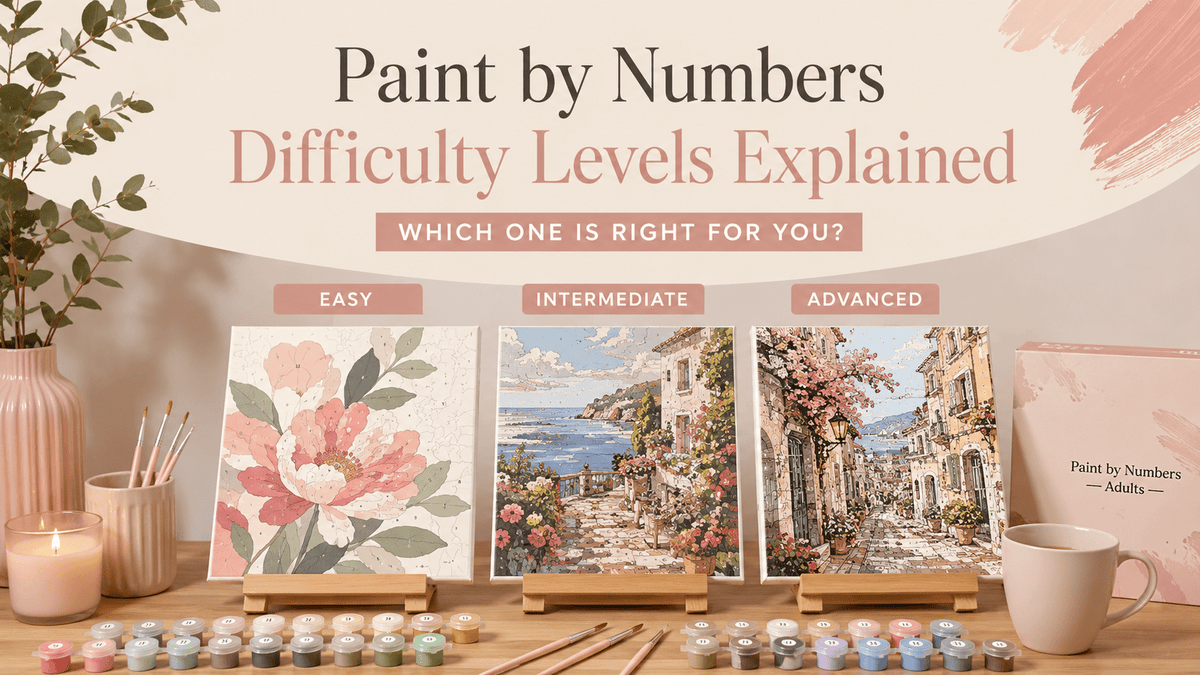
An easy paint by numbers kit gives you room to learn without making every brushstroke feel delicate. Look for larger sections, clear outlines, strong contrast, and few micro-spaces. Many beginner-friendly designs use roughly 18 to 24 colors, although layout matters more than the total.
For a common 16 x 20-inch canvas, an easy project may take about 10 to 20 hours. You will still build useful skills: loading the brush, painting to an edge, covering printed numbers, and keeping acrylic paint at a workable consistency.
Good first choices include bold florals, graphic animals, simple still lifes, and landscapes with broad areas of sky, water, or fields.
Do not assume a smaller canvas is automatically simpler; compressed details can make it unexpectedly demanding. For a shorter project, browse our mini kits, but inspect the preview for section density.
Easy should mean approachable, not childish. Younger painters are better served by designs made specifically for kids.
4. Intermediate level: when you've done one already
Intermediate is the comfortable middle for many returning painters. You already know how acrylic behaves, how quickly it dries, and how much paint belongs on the brush. Now you can handle mixed section sizes, subtle shading, and detailed areas without feeling that every inch is slow work.
A typical intermediate kit may use 24 to 36 colors and take 20 to 35 hours on a 16 x 20-inch canvas. Expect broad backgrounds alongside smaller leaves, window frames, facial shadows, or patterns. The challenge is switching brushes and keeping boundaries clean as the image becomes more complex.
This level suits you when your first painting felt enjoyable and left you wanting more detail. It can also fit a patient beginner who is comfortable working on one project over several weeks.
Single-animal portraits, botanical scenes, cafés, beach views, and simple figures often fall into this category. Choose intermediate when you want visible progress in each session but do not mind spending twenty minutes on one important focal area.
5. Advanced level: for ambitious painters
Advanced kits are for painters who enjoy detail for its own sake. They may include 36 to 48 colors or more, many narrow spaces, subtle transitions, and focal points where an imprecise stroke is more noticeable. A hard paint by numbers design does not require formal art training; it demands patience, brush control, good lighting, and slow work.
On a common 16 x 20-inch canvas, a detailed project can take 35 to 60 hours or longer. Fur, feathers, faces, reflections, foliage, ornate buildings, and crowded streets create clusters of tiny shapes. Similar shades also slow your rhythm because you must check the numbers instead of relying on visible contrast.
Advanced is right for you when small sections feel satisfying and you can leave the canvas set up between sessions. It can also suit a meaningful custom photo, provided you are ready for the detail needed to preserve expressions or distinctive pet markings.
Pick this level because you enjoy the process, not because a harder label sounds more impressive.
6. Comparison table: colors, sections, hours
The table below gives practical planning ranges for a typical 16 x 20-inch adult kit. These are estimates rather than guarantees: your painting speed, paint coverage, design complexity, and use of second coats can all affect the total.
| Level | Typical color range | Section pattern | Approximate painting time | Best fit |
|---|---|---|---|---|
| Easy | 18–24 colors | Mostly large and medium sections with few micro-details | 10–20 hours | First kit, quick progress, relaxed sessions |
| Intermediate | 24–36 colors | Balanced mix of large, medium, and small sections | 20–35 hours | Returning painters or patient beginners |
| Advanced | 36–48+ colors | Many small, narrow, or tightly clustered sections | 35–60+ hours | Detail lovers and long-form projects |
Use these ranges to estimate your commitment, not to rank the quality of the finished picture. An easy canvas can look beautifully polished, while an advanced canvas is not automatically more attractive.
When comparing kits, enlarge the preview and inspect the subject, background, and places where similar shades meet. Those details reveal more about the painting experience than color count alone.

7. Which motifs match which levels?
Motifs have general tendencies, but no subject belongs permanently to one level. A lion created with bold pop-art shapes may be easy; a realistic lion with layered fur, whiskers, and facial texture may be advanced.
As a starting point:
- Easy: Graphic florals, silhouettes, bold abstracts, simple still lifes, and landscapes with large skies or water.
- Intermediate: Single pets, botanical illustrations, street cafés, beach scenes, and portraits with uncluttered backgrounds.
- Advanced: Close-up fur or feathers, several people, complex architecture, night reflections, dense forests, and intricate famous artworks.
Animals are especially variable. A graphic elephant can have generous spaces, while a realistic tabby may contain hundreds of short color changes.
Landscapes vary just as widely. A sunset with broad color bands is approachable, but a forest with overlapping branches, rocks, and reflected light can be demanding.
Choose a motif you genuinely care about, then inspect how it has been translated into numbered areas. Motivation helps you continue, but suitable structure keeps the project from turning into frustration.
8. Size and difficulty - how they relate
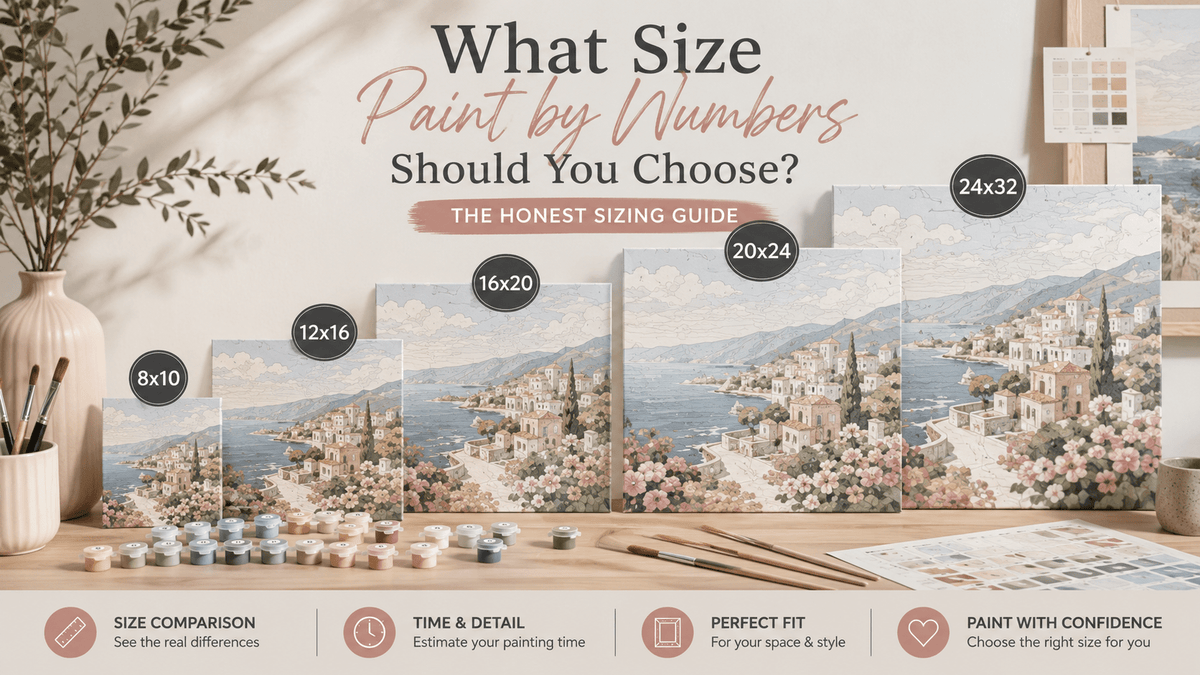
Canvas size changes both precision and workload. When the same detailed image is printed larger, each numbered area has more room. That makes faces, fur, windows, and outlines easier to paint cleanly. The larger version may feel less fiddly even though it gives you more surface to cover.
A smaller canvas requires less table space, but it may compress important features into tight clusters. Beginners should not automatically choose the smallest available option. A medium format such as 16 x 20 inches often provides a useful balance: enough room for readable sections without creating an oversized project.
The image still comes first. A simple design can remain manageable at a smaller size, while a family portrait, detailed pet, or busy streetscape benefits from more space.
Consider your eyesight, hand steadiness, workspace, and preferred project length. Our size guide explains the available canvas choices in more detail. Size can make fine details easier to execute, but it does not remove the time required to paint them.

9. What to do if you've overestimated yourself
A kit that feels too difficult does not need to become an abandoned project. Stop measuring your progress by how much of the canvas remains. Cover most of it with clean paper and expose one working area. A crowded design feels calmer when you see six inches instead of the whole picture.
Then adjust your method:
- Paint the largest sections first for quick visual progress.
- Work with one color for 20 to 30 minutes, then take a break.
- Use strong lighting and magnification for tiny numbers.
- Keep a fine brush for narrow spaces and use a larger brush wherever it fits.
- Add a second thin coat later instead of chasing perfect coverage immediately.
You may also merge a few nearly identical background shades while preserving important outlines. There is no requirement to reproduce every minor boundary mechanically.
Your painting should look good from a normal viewing distance, not only under a magnifying glass. Most importantly, let the project take longer. A small daily goal can turn an overwhelming kit into a satisfying long-term piece.
FAQ
1. What does “easy” actually mean?
“Easy” means the canvas has larger sections, clearer contrast, and fewer precision-heavy details. It does not mean the artwork looks childish or plain. An easy adult kit can still produce sophisticated wall art; it simply gives you more forgiving spaces and faster visible progress while you learn brush control and paint coverage.
2. How many colors does an advanced kit have?
An advanced kit commonly has about 36 to 48 colors, and some designs use more. Color count alone does not determine the level, however. A 24-color canvas can still be difficult when it contains hundreds of tiny sections, while a 36-color design may feel smoother if its areas are larger and well separated.
3. Should I pick a small kit as a beginner?
Not automatically; a medium canvas is often easier for a beginner to paint cleanly. Small canvases take less space, but they can squeeze eyes, leaves, fur, and other details into very tight areas. Choose a simple image first, then use size to balance readability, painting time, and your available workspace.
4. Are animal motifs easier than landscapes?
No—either motif can be easy or advanced depending on how the image is divided. A bold animal silhouette may be simple, while realistic fur can be demanding. A landscape with broad sky and water may be easy, but dense trees, rocks, buildings, or reflections can create many small, time-consuming sections.
5. Can I jump from easy to advanced?
Yes, especially if you are patient and genuinely enjoy fine detail. Expect the advanced kit to take considerably longer, and set up good lighting before you begin. If your first project taught you clean edges, thin coats, brush care, and how to pace your sessions, you already have the essential foundation.
Ready to choose a project that matches your patience and painting style? Explore our full range of paint by numbers for adults and start with a canvas that feels inviting—not intimidating.